
If you spend time exploring the Big Island, you will inevitably hear stories of Pele, ancient Hawaiian gods, and the legends woven into our mountains, craters, and rainforests.
These narratives are part of moʻolelo, a rich tradition in Hawaiian culture that encompasses history, genealogy, tradition, and knowledge passed down through generations. While the word is often translated simply as “story,” moʻolelo carries a much deeper weight. It preserves real history, explains the natural world, embeds cultural values, and links the Hawaiian people directly to the land (ʻāina).
In Volcano, you encounter these connections everywhere you turn. Pele’s presence is felt at Kīlauea’s rim. Poliʻahu watches from the snow-dusted summit of Mauna Kea. The ʻōhiʻa tree speaks to devotion, and even the bungalows at our Big Island bed and breakfast are each named after a Hawaiian goddess.
Understanding moʻolelo offers a richer, more respectful lens through which to experience the island.
What Does Moʻolelo Mean?
In traditional Hawaiian society, history was maintained through an oral tradition. A moʻolelo could record an ancestral lineage, explain a weather phenomenon, or pass moral guidance to the next generation.
Because these stories were shared aloud across different islands and families, variations exist naturally. You may hear slightly different versions of the same Hawaiian story depending on who is telling it and where their family originates. Rather than searching for a single, definitive text, reading a moʻolelo means stepping into a living, evolving tradition.
Hawaiian Gods and Goddesses in Tradition
When travelers research Hawaiian mythology, they are often searching for stories about Hawaiian gods and goddesses. In the Hawaiian worldview, these figures, known as akua, are not abstract characters living apart from the world. They interact directly with people, plants, winds, ocean currents, and landscapes.
Many akua express themselves through kinolau, physical forms in nature, such as a specific tree, rain pattern, or ocean animal. Here are several prominent figures you will encounter around the Big Island and on our property grounds:
Pele
Pele is the akua most intimately tied to Volcano. As the deity of fire, lightning, and volcanic activity, her home rests in the Halemaʻumaʻu crater at Kīlauea. The epic moʻolelo of Pele and her sister Hiʻiaka, who journeyed across the island chain to Kauaʻi and back, remains one of the most celebrated narrative cycles in Hawaiian literature.
If you’ve stayed in our Pele Bungalow, you’ve probably noticed that the name is particularly fitting for a property in Volcano.
Papahānaumoku
Papahānaumoku (often called Papa) is the Earth Mother. In Hawaiian traditions, she is associated with the creation of the Hawaiian islands alongside Wākea (the Sky Father). Her presence represents the deep, nourishing foundation of the land beneath our feet.
At Volcano Village Estates, our Papa Bungalow honors this deep connection to the land. From your window, the bungalow looks directly out into the lush canopy, offering a quiet front-row seat to the living rainforest that Papa helped create.
Hina
Recognized as the goddess of the moon and a master maker of kapa (traditional bark cloth), Hina’s connection to the lunar cycle is so deep that the Hawaiian word for moon, mahina, derives directly from her name.
Our Hina Bungalow reflects this peaceful, nighttime energy. With warm wooden accents and moon-inspired artwork set above the bed, the room is designed to feel like a serene sanctuary after a day spent exploring the park
Laka
Laka is celebrated as the patron akua of hula dancing, forest growth, and lei making. She represents beauty, movement, and growth. A gentle counterpart to the fiery destruction of volcanic creation.
Inspired by her domain over the native plant world, the Laka Bungalow sits immersed in the estate’s lush surroundings. With expansive windows and a cozy daybed overlooking vibrant tree ferns and rainforest canopy, it offers a tranquil retreat centered on the beauty of the surrounding forest.
Poliʻahu
Poliʻahu is the Hawaiian goddess of snow, residing on the high slopes of Mauna Kea. Her stories often depict a rivalry with Pele, a poetic reflection of the natural meeting point between ice and fire on the Big Island’s highest elevations.
That sense of cool elevation and clarity carries directly into our Poliʻahu Bungalow. Designed with light-filled windows and clean white linens, the suite creates a bright, airy contrast to the dense, dark green rainforest surrounding it.
Kāne and Kanaloa
Not all primary figures in moʻolelo are female. Kāne is associated with life-giving freshwater, sunlight, and creation, while Kanaloa is tied to the deep ocean, navigation, and ocean life. In many traditional stories, Kāne and Kanaloa travel together across the islands, opening freshwater springs wherever they strike the earth.
Moʻolelo Can Be About Places, Too
In Hawaiian culture, stories aren’t only about gods and goddesses. They’re deeply attached to physical places (wahi pana) and the environment. A mountain, a lava tube, or an old-growth tree is rarely just a physical feature; it carries a name that remembers an event, a chief, or an interaction with an akua.
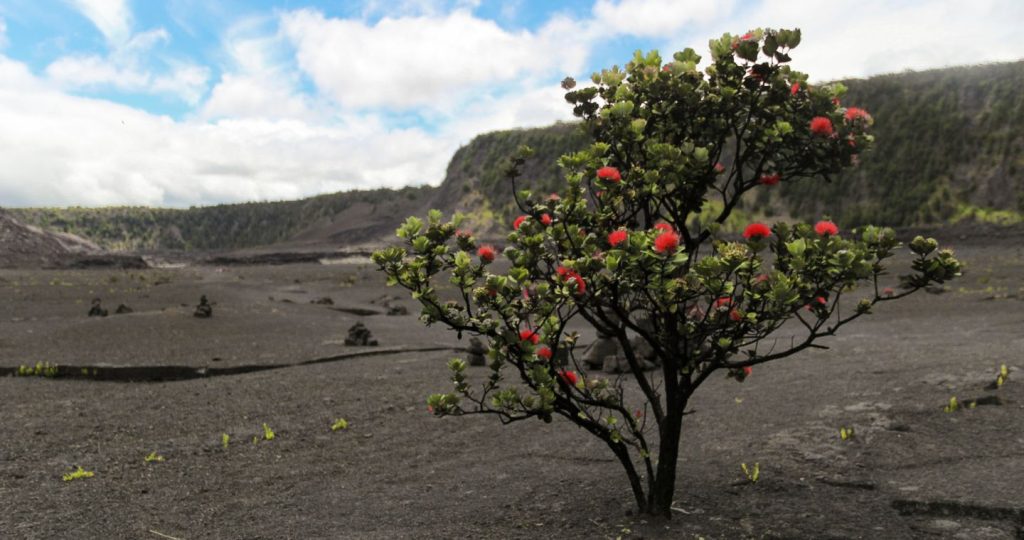
For example, the ʻōhiʻa lehua tree, which dominates the rainforest canopy surrounding Volcano, is tied to a famous moʻolelo of two lovers transformed by Pele into a tree and its blossom so they could remain together forever. When you know the story, walking through the rainforest becomes an entirely different sensory experience.
A Living Tradition
It’s easy to think of mythology as something that belongs to the distant past. Hawaiian moʻolelo is different. Kumu hula, cultural practitioners, and storytellers continue to pass down, study, and honor these traditions.
Geology explains how a volcanic hot spot creates an island chain through rock and pressure. Moʻolelo explains the cultural and spiritual relationship people share with that same land. Both perspectives add depth to our understanding of this unique environment.
The Story Behind Your Stay
At Volcano Village Estates, these traditions are woven directly into our grounds. We named our private bungalows to honor these foundational figures and the land around us.
During your stay, we invite you to learn a little about the story behind your room’s name. As you explore Hawaiʻi Volcanoes National Park, walk through the rainforest, or simply spend time around Volcano, you may start to recognize those names, places, and stories in a new way.
You don’t have to know every story before you arrive. You can learn a little as you go. And when you stay with us, you have a comfortable place to come back to while you do.